Art, Item 7 & Design Thinking: Is Lagos the Wrong Kind of Inspiration You Need as an Artist?
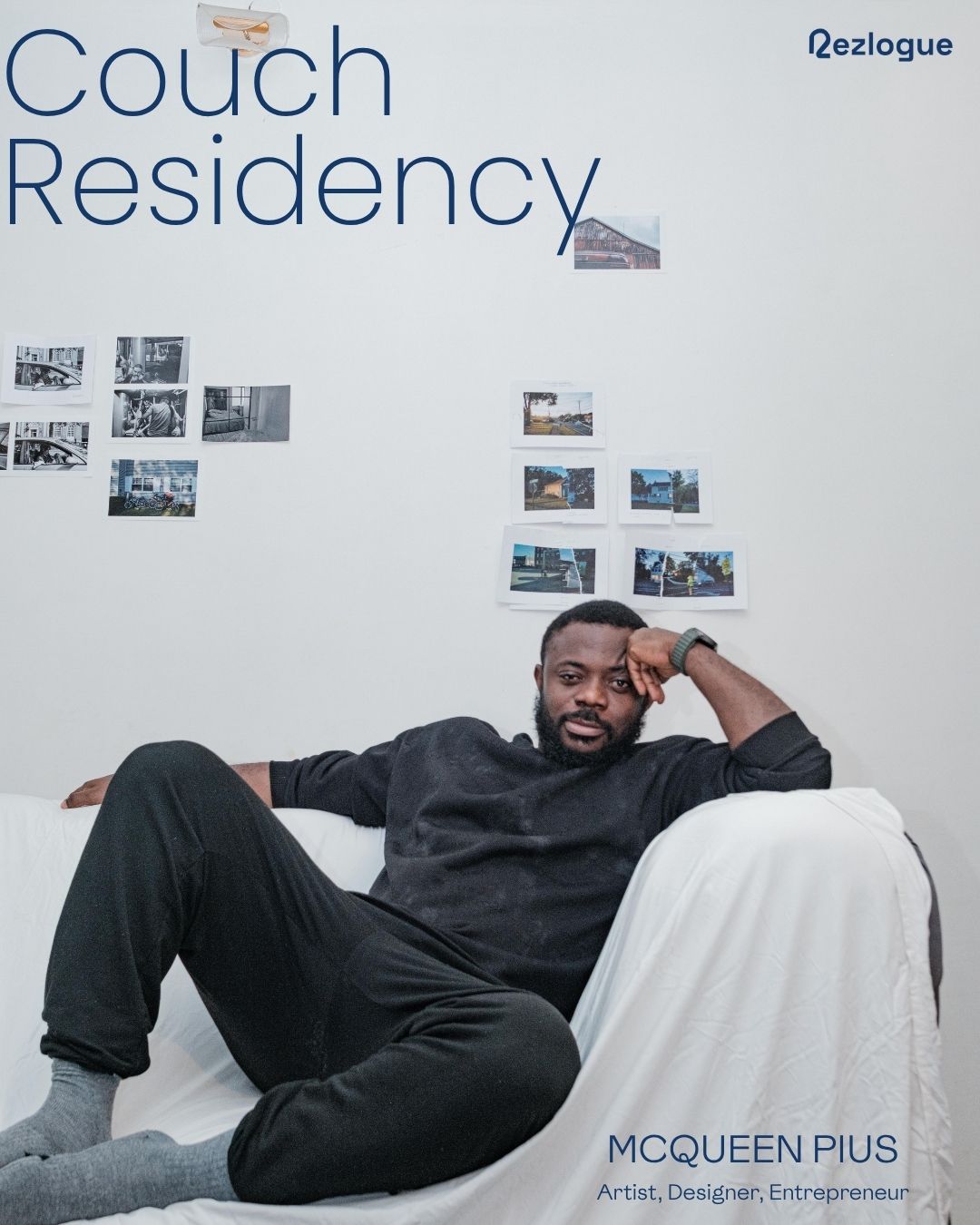
Rezlogue Couch Residency I (July 2026) with McQueen Pius; Artist, Designer, Serial Entrepreneur.
So I was making art in Ile-Ife, and it was a small place where you could make your own community and stuff. But Lagos was one of the things that made me realize that I needed to make money. I didn’t really like the art scene per se in Lagos because it felt very pretentious. At some of the events I went to, everyone was trying to be cool instead of actually making art. And I didn’t care about what you’re wearing or how cool you are like that. I thought if we were going to create something, let’s just create something. It doesn’t mean that they’re not great artists and art that I saw.
So you left the country, and now that you came back, you’ve been here for, like, a month? And at this residency for about a week now. What has been interesting? Has anything shifted for you? And you’ve not been in Nigeria since you left, and you were in Kigali. Has anything shifted for you since then? You’ve been to a few galleries, some events, you’ve seen some street art that you had some criticisms of.
Before I learned how to draw, I would look at art, and I’m like, how did this person paint this? How did this person make this? And then maybe because I’ve learned how, I’ve been in that space, learned how to draw, seeing a very nice painting isn’t it anymore for me. Now I ask what story it is telling. How has this moved me?
And it hasn’t really shifted based on the things I saw. I don’t know; I’ve not really gone out, I’ve not gone out for that long, but with the little I’ve seen. Being a fan of street art, and some of the things I’ve seen in Lagos, Nice, but…
I’m very particular about experiential experiences. It should feel like a movie. You should feel moved, like you want to do something after. Some of the events I’ve gone to, they feel like get-togethers, and even that should still be experiential. There are fine clothes and beautiful people, but there’s nothing for me to take home.
Now, I’ve not been to everything, but based on me being back at home, it looks like everyone is just on a surface level; nobody’s telling stories that will change your life. Like, ah, that’s changed me, changed my perspective about something.
 How does it compare to Kigali?
Kigali’s worse in the sense that they’re not as expressive. We’re the expressive ones. For someone who’s an artist, I haven’t been present in that space in the last 5, 6 years. I have been learning the business side of things. I went to the galleries in Kigali a number of times, and I thought there was space for growth, but it can’t compare to Lagos.
But that’s kind of sad if you were in Kigali and you didn’t feel any kind of substance, and then you come here, and it’s a touch better, but not much. The question becomes: what would you like to do? Would you like to spend more time in Lagos? And having experienced Kigali, and having come back to Lagos, what does it make you want to do?
I wanna tell stories. A lot of people are telling stories, but there are some stories I heard or experiences I had growing up that morphed who I am. I feel like we’re telling stories, but we’re not telling stories that impact. It almost feels like everything is a show, to be entertaining. I want something serious, something serious, something deep. Serious, but also fun. Like, experiential. To go somewhere, go for an event, and have goosebumps.
What you just said makes sense, but it’s also still kind of broad. Is there anything you saw that’s connected with you on the street?
Maybe not so much art. But Item 7. Item 7 gave me goosebumps. Number one, the simplicity – that they took an idea that’s right in front of everyone, the buka style, and then built a system around it, and cleaned it up, and then the food is amazing, and then it’s not expensive. I kept looking at the place; I was smiling all through. I was thinking this is so good. Aside from that – and we’ve been moving around on the island a lot- I’ve not seen any other thing that I’m like, whoa.
So, thinking about Item 7, it leads into a conversation about design. Because you’re a designer as well. Okay, now maybe can you introduce yourself a bit? Like, you’re a designer, a businessman, business mogul, entrepreneur, serial entrepreneur.
Designer, artist, cook, chef, I’ve dabbled in a lot of things, but now I run a digital agency where we believe that the best way to market and push yourself out there is by understanding your identity. When you understand your identity, you’ll find your people easily. So, we are an identity-first sort of agency. That’s what I’ll do now, but I’m picking my art back up. Once I get back into Kigali, I have some ideas.
Yeah, maybe you can say Lagos has inspired you?
No, Lagos has – you guys have actually inspired me. Talking to you guys, I realized I don’t even know so much about the art space, like, the system itself. I just know art.
So, as a segue into design, I’ve heard you complain about buildings here. Which is not about art per se, but, you know, there’s a correlation with art and design, right? Yes. Can you talk about that?
So, art is subjective. Art isn’t exactly solving an objective problem. Art is experiential. You express and feel emotions. Design is supposed to solve a problem. Design is supposed to be objective. If someone gives you a chair and you can’t sit down on it, it’s a terrible design. Objectively, you’re supposed to be sitting down and be comfortable. Art and design can interplay where you’re supposed to do something while it’s still solving the problem.
Now, when you travel and come back, you realize that Lagos really is not designed to be a walking city. A lot of people walk because transportation is expensive, but when you don’t design a city like this to be walkable, there are so many things wrong.
And there are so many things wrong with Lagos in terms of design, and the one I’m just realising is the houses. I’m tired. Everything is templated. It’s some Nollywood nonsense standard. Nollywood Core. There is a chair in your house where your legs can’t even touch the ground, and it’s not because you’re short but because it must feel like a throne. ? And why is everything white? We don’t design for function. We’re designing for an aesthetic that looks like something from Pinterest – even the tiles, the ceilings, everything, tiny windows. Instead of designing for fresh ventilation, everybody is using A.C. There’s a headboard covering the whole window. Just the bed frame is taking all the space that you could use for something else.
So, I mean, the lack of design that you talk about is now reminding me of when we were driving from VI back here, and you saw this design on a signpost with this typography…
 So, it’s the age of AI, where everyone is using AI. One of the things I always look out for when moving around is design and copy. And I’m always asking myself, do people actually look at this and buy it? Does this spur people to buy it? And then I see some copy, and I’m like, this thing looks nice, but you don’t get the point of the design. It’s supposed to help sell, and people see. So we’re driving, and we see this billboard. I was looking at it; I couldn’t figure it out until we were so close. I’m like, someone could be interested and have an accident while they were looking at it.
The choice of typography aesthetically looks nice, but when you’re driving, you’re supposed to see immediately and decide whether you want to buy it or it registers in your mind. But maybe they were doing the reverse, because maybe when you fixate on it a lot, you think about it; who knows? I think a lot of designers here understand the use of the tools, not design thinking.
Because I see a lot of visuals here in Lagos, compared to what I see in East Africa. Yeah, we have mad visual designers, but I don’t think a lot of them understand design thinking, because design is supposed to solve a problem. Like, if I’m designing something, it’s supposed to solve the problem. And I don’t see a lot of problems being solved. So when you go around and you’re seeing people’s houses, and even designers’ and artists’ houses, and they all just look like something from a Pinterest template. It’s like, okay, what am I doing here? I’ve been to a couple of houses, and everything looks like an extension of the other. It’s all the same. We’ve lost personality in terms of expressing ourselves in design and art.
What are you working on, based on you coming from Kigali to our country? What’s brewing?
You can’t say all this kind of nonsense that I’ve said and not want to show that this is how it should be done. So, what is brewing is a couple of projects that I’ll be telling some stories, because it looks like I’m also at fault, because if I was telling my stories and doing it well, maybe it would’ve inspired some persons to be original. It’s Lagos. It looks like everyone has gone commercial because everyone wants to make money, and because everyone wants to make money, which is fine; I get it, you sacrifice the real thing for what’s selling right now. And what’s selling right now is very shallow.
What are you going to make?
I’m going to make art, products, experiences, paintings, and content that are very different. Real stories, not sacrificing the debt for consumerist culture.
What’s your experience in this house?
There’s always a conversation to be had. I’ve experienced different perspectives. I’ve eaten, drank zobo, and made food- pepper soup; today, we’re going to make okra. Even though the house looks like a Nollywood set. They are victims of Nollywood Core.