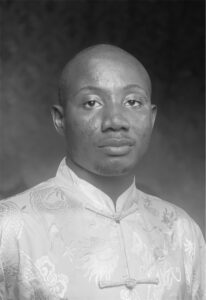
What project were you investigating or developing during your residency?
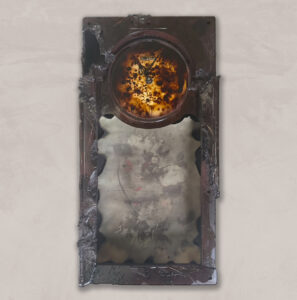
While in residence at Nchedo, I started investigating how memories and archives, and their consequential erasure, are influenced by individuals. My earlier works explored erasure courtesy of time, but the residency became a space where I explored erasure courtesy of human influence. I inquired through the lens of Jacques Derrida’s Archive Fever and Achille Mbembe’s The Power of the Archive and Its Limits, examining how individuals use archives and memories as a means of navigating grief, loss, and absence through acts of erasure.
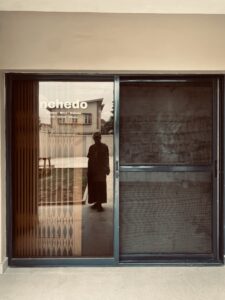
In what way did the environment, resources, or community around you influence your residency experience or its outcome?
The environment at Nchedo took away the pressure of having to navigate my regular work alongside finding time and space to create. The peaceful and conducive atmosphere allowed me to slow down, think, experiment and engage more intentionally with my practice. Beyond providing a physical space to work, the environment encouraged my desire to create and gave me the freedom to explore ideas without the usual constraints of everyday responsibilities. The resources provided by the residency also significantly influenced my research and experimentation. I particularly enjoyed spending time in Nchedo’s library, where I encountered books that introduced me to new technical approaches and ways of thinking, some of which I incorporated into my works. The residency also provided materials and other resources that supported my research, experimentation and production, allowing me to test ideas that I may not have otherwise explored. The community was equally important to the development of my practice. Conversations and exchanges with the other artists in residence allowed me to see my work through the perspectives of other creatives. These conversations challenged some of my existing ideas and helped me better express how I understand and articulate my practice as regards the principles and elements of art in my practice. The different publications, books and materials shared during the residency also disturbed and reoriented my understanding of my work. One significant encounter was a poem from a publication shared with us by Chidinma Nnoli, Nchedo’s founder. The poem prompted a personal reflection that eventually developed into a Substack post after the residency. Experiences like this demonstrated to me how an encounter with a text, an artist, a material or even a conversation can open up new directions within my practice. Nchedo gave me not only the environment and resources to produce work, but also the intellectual and communal space to question, reconsider and expand the way I approach my practice.
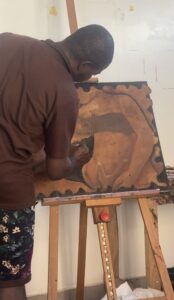
Looking back on the residency, is there a specific experience or moment that continues to resonate with you?
The studio visits resonated with me deeply. Our visit to Kwadwo Aseidu’s studio was particularly memorable, as we had meaningful conversations about our practices, the challenges we encounter, and the directions our work is taking. Seeing Ayobami Ogunbe’s process and how he translates ideas into material was also mindblowing.
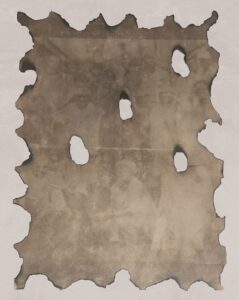
Did any new ideas or projects emerge during the residency that you hope to continue developing?
Prior to the residency, I had considered experimenting with printmaking in my practice, but cyanotype printing was not something I had initially considered. My interest in the process developed through my interactions with Charles, a fellow resident artist and my studio mate, as I observed him preparing his cyanotypes. I was drawn to the distinctive effect of the process and decided to experiment with it, resulting in two prints. I am currently continuing to explore cyanotype printing, incorporating my own visual language into the process as I investigate how it can expand the possibilities of my practice.
What is currently inspiring your thinking or practice (a book, film, conversation, research, place, etc.) and why?
Achille Mbembe’s The Power of the Archive and Its Limits and Jacques Derrida’s Archive Fever are writings that currently influence how I approach my practice. I am also looking at Africanus Okokon and the ways in which he approaches his practice, particularly how his ideas find beautiful and diverse expressions across different media.