What project were you investigating or developing during your residency?
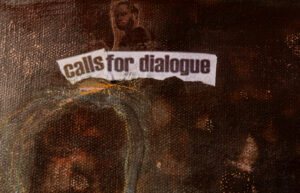
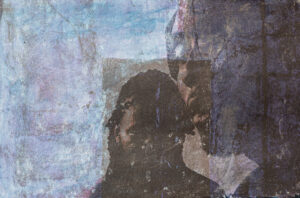
Before the Nchedo residency, my primary medium was photography and film. For about four years, I’ve been working on an archive in Ghana, collecting stories from the community, photographing community events and reimagining identity within the community. I had experimented with prints and anthotype, which is basically using sun printing and plant-based dye to transfer photography onto paper. But it fades out, so I wanted to try a different direction. I decided to experiment with acrylic gel medium on canvas and explore ways of making my photographs and archives exist in a different form. I went into photo transfer because I’m a photographer first, and even when I’m experimenting with different media, I want the photography to remain present.
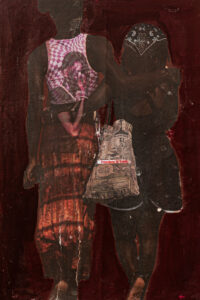
The body of work was initially titled Look at Me Again. It was about making my photography exist in a different form while continuing to share the stories of the people I had photographed. When I went back to Ghana, I gave it a different name, My Body Has Dreams. What I wanted the body of work to represent was a community that is lively, a community that is very open. Love exists. A community that looks out for each other. And also a political statement.
When I was archiving, I started asking myself, “Am I just photographing stories? What am I going to do with the stories?” I wanted more out of the photographs. I realized that not many people in Ghana are making their art political, I would say, so I decided to go that route in my body of work. My Body Has Dreams was a means for my people, my friends, to exist. The series considers visibility. I wanted to make my people/community visible, but it was also central to my personal existence, how I live, how I see my friends live their lives, and the stories I get from the people I photograph. It speaks about visibility, collective belonging, what is said and what is left unsaid. It’s about how people are misunderstood in their own identity, histories that have been erased or restricted, and the possibility of reinvention and self-definition.
How did your time at this residency shift, expand, or challenge your practice?
My first experience with gel medium wasn’t very good because I already had an idea of how I wanted my photos to look. When I started peeling off the paper, I realized that I was actually peeling the paper itself instead of just the white sheet, so the ink was peeling out. It was really going badly.I wanted to change it, but then my mentor encouraged me to let go of that expectation and allow the work to unfold. So I had to just relax and do the work. And honestly, it’s been good. What I also wanted to work with at Nchedo was textile. But since I hadn’t used gel medium before, I decided to do it on canvas instead of the cotton fabric I originally wanted to use.
What kind of support during the residency was most meaningful to you?
The library and the space itself stood out for me. It’s a very peaceful place, very calming, and there are so many art books in the library.
Because I was experimenting with new mediums,, I spoke to Chidinma Nnoli about getting certain books that could inform my process. Amara also suggested some books for me to read, and that was when I started finding different ways to experiment with photo transfer.The books informed a lot of my experiments. I started experimenting with the sun, sand, collage and painting on paper just to see how I would flow with it, because I’m not a painter. They also guided me on things like how to use pastel and which brushes to use. All these things, I didn’t know, so I found them in the books in the library.
My colleagues were also very important because they were all painters. If I wanted a certain colour mix, I could ask them how to get it. I also had to ask them about patterns, and that was how I learned how to use tissue in my work.
My mentor also helped me think through the direction of the work. She was experimenting with other mediums alongside her photography, so she informed my work in a way, as a mentor would do. I had questions and would go to her for directions.
When it came to the technicalities, the books and my colleagues were the main points of contact, while my mentor helped direct how my work could go.
What is currently inspiring your thinking or practice (a book, film, conversation, research, place, etc.) — and why?
My archive is taking a different form now, so that’s what I’m currently exploring and researching.There’s this thing we say, Preman. Preman is basically someone who dresses flamboyantly, someone who is really out there. When someone says Preman, they are referring to people who are living their life visibly, people that don’t care. And sometimes it is associated with negativity. I’m reimagining that with my community and putting people in that aspect. My research is basically going into that, sitting with elders and talking about it.
I remember one research I made where there was a time that one village wanted to ask a woman to be the queen mother of Preman. But that didn’t happen because the men were against it. They were like, “Why do you want to put a woman as the queen mother of Preman?”Because when a man says you are Preman, they are actually associating Preman with negativity. So basically, that is what I am doing now.
I’m also conceptualizing the geography of myself. Recently, I’ve come to realize I have selective memory. I’ve had memories coming up from my childhood that I didn’t even remember, and I don’t even know whether they are real or not.That’s an investigation that I’m doing. The body of work is basically conceptualizing and exploring my childhood isolation and the architects of home. That’s not a career-related project, but it’s a mixed-media project on myself.