What project were you investigating or developing during your residency?
During the residency, the aim was to build something from scratch. Coming from the North, Kaduna to be precise, into a city I wasn’t familiar with, I wanted the city itself to influence what I would make.
The theme for the OUT Residency was Epignosis I: Our Stories First. So, I started thinking about how I could tell a story using the things I already practice in my photography. My work is mostly centered on people, places and culture, but coming into Lagos, I noticed something else that sparked a new interest. Or maybe it wasn’t entirely new, because I realised I had actually been collecting these kinds of photographs in small doses without really knowing it.
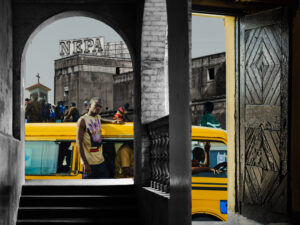
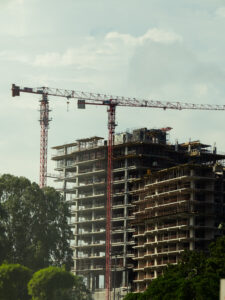
I became very interested in the architecture of Lagos, especially the older buildings, the tall structures that are not so common where I come from, and the way old and new exist beside each other. I started thinking about how these buildings are changing the face of what once was, while people continue to inhabit, work in and move through these spaces. It brought me back to the things I have always photographed: people and places, but from another perspective.
I also wanted to find a way to bring the buzzing nature of Lagos into the work: the traffic, the movement, the chaos, the people and the everyday hustle. I wanted to see if I could bring all of these things together in a way that felt different from simply presenting individual photographs.
This led to the main piece I developed during the residency, The Threshold of Eko. The title comes from the idea of entering and looking into Eko, Lagos, from a place of encounter. A threshold is a point of crossing, and for me, the work sits between different things: the old and the new, the past and the present, the built environment and the people who inhabit it. It is also about my own entry into a city I did not know and what I encountered once I crossed that threshold.
In what way did the environment, resources, or community around you influence your residency experience or its outcome?
I was heavily influenced by the architecture and structure of Lagos itself, the people, and what they carry. The residency also provided many of the resources I needed to develop the work. One of the most important was the facilitation and mentorship sessions, where I had the privilege of interacting with incredible master artists and professionals in the art world. The other residents and our House Lead also influenced this body of work greatly. Their suggestions, advice and input made me realise that I could do and be more with the work I was already making, and I am very grateful for the opportunity to interact and be in the same space with people like that.
The environment itself also helped. It was sane and refreshing, and gave me somewhere to think and gather my thoughts whenever I felt overwhelmed. I think that space, the people around me and the conversations we had all became part of the process, and eventually influenced the outcome of the work.
Looking back on the residency, is there a specific experience or moment that continues to resonate with you?
There are a lot. Two out of all the experiences that resonate with me the most, though, were visiting Kelani Abass’ studio and spending half a day learning and unlearning, and the road trip to Badagry.
The visit to Kelani Abass’ studio really made me think about my practice and how I could approach photography differently. Seeing his process and spending that time in the studio made me question some of the things I had always assumed about how I should make and present work.
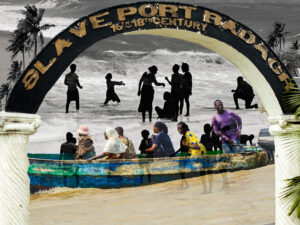
The Badagry trip changed my perspective in a different way. Learning about the history of the slave trade and being in those places made me think a lot about how history continues to exist alongside the present. I remember thinking about how people were taken across those waters and never returned, while today, people still come to these same places to spend time, relax and escape from the chaos in the city.
That was where the title of one of my pieces, Point of No Return; Modern Day Sanctuary, came from. I was thinking about what the place once represented and what it has become today, and the title came from that contrast.
The two experiences made me look at my work differently. One made me think more about what I could do with my photography, and the other made me think more about the importance of documenting and preserving the stories attached to the places we pass through. If we don’t tell our stories, someone else will tell them for us, and they may not tell them the way they happened.
Did any new ideas or projects emerge during the residency that you hope to continue developing?
Yes. I am currently looking at going into mixed media and experimenting more with digital collages.
I also want to expand my architectural collections around Nigeria. I have become much more interested in these buildings and what they tell us about where we have come from. A lot of them are part of our history, but they are slowly disappearing or changing because of modern development.
I want to start documenting them more intentionally, while also looking at the people who inhabit these spaces and the stories connected to them. It is quite a lot of work, but I will start from somewhere.
What is currently inspiring your thinking or practice (a book, film, conversation, research, place, etc.) and why?
Conversations, the places I have visited recently, and the things I have been learning. I think I am currently very curious about what was. Visiting places like the Old Secretariat, Jaekel House and Badagry, and learning about their histories, made me start paying more attention to what existed before the present version of a place. The old buildings I encountered in Lagos have also made me curious about who built them, who lived in them, what happened around them, and what remains of those stories today.
I have also been reading John Berger’s Ways of Seeing, and it has made me think more about how we look at things, what we choose to notice, and how our own position affects what we see. I think that connects with what I have been experiencing in Lagos, especially because I came into the city with a way of photographing that I was already familiar with, and the OUT Residency made me look at things differently.
I think that curiosity is beginning to affect the way I photograph. I mean, it always has, but differently this time. I am not only looking at what a place looks like now, but also thinking about what came before it and what might disappear if we don’t pay attention.
I am becoming more interested in the stories that are still sitting in these places, even when you don’t immediately see them.