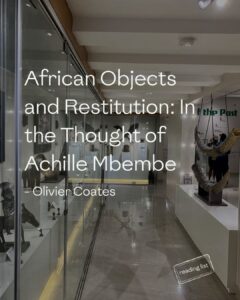
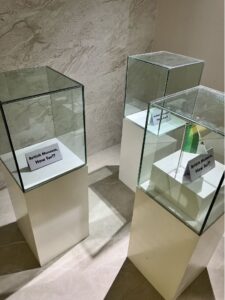
- At the National Museum in Lagos, there are a few empty pedestals with confrontational notes that ask, roughly, “British Museum, how far?”
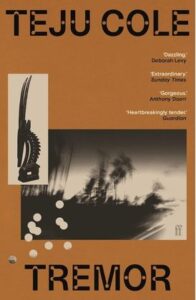
- One of Teju Cole’s protagonists in Tremor (2024), during a university lecture, responds to a paternalistic questioning of calls for restitution. His response is reflective as he suggests that there must be new possibilities for museums, and that we need to move beyond ideas that the West understands more or better, or can appreciate or care for them better than the makers who have sacralized these art objects beyond aesthetic value. Tangential to this paternalistic viewing is Liam Buckley’s argument for the “right to allow for decay” regarding archives.
- Oliver Coates’ African Objects and Restitutions centers on Achille Mbembe’s thoughts, or more precisely, his critique of the current dimensions and latitudes of the calls for restitution.
The article highlights Mbembe’s position on restitution that goes beyond the act of return and the practical framework for bilateral return, further lending itself to the philosophy that genuine restitutions would necessitate “a reckoning with Europe’s treatment of Africa on a large scale.” Mbembe perceives the colonial encounter as generative of several destructive readings or interpretations of African objects, which later become normative in European aesthetics.
The article further touches on the new damage done to objects after they arrived in Europe, including dismemberment and modification, which ignored their original context and cultural framing. The critique of African art replete in the past century particularly minimized and ignored Africa’s innovativeness with regard to material cultures. The colonial encounter was, for Mbembe, an assault on African cultural, religious, and social domains which extended across time – the importance of the objects beyond aesthetic quality is stripped. These taken objects are active agents within social life, and they challenge the boundaries of the human such that “the boundaries between human and object, living and material worlds become blurred”.. The objects play “a properly philosophical role within the culture” and connect humans with “vital powers.” Therefore, it is not only the objects themselves that are lost but also the vital energy they circulate.
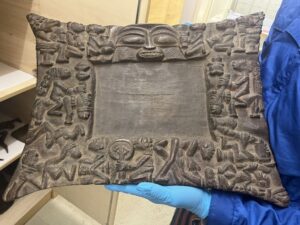
Weltkulturenmuseum, Frankfurt
Photo: Rezlogue
Speaking on the archive, the scholar notes that when destruction of the material occurs, it only strengthens the power of collective memory.
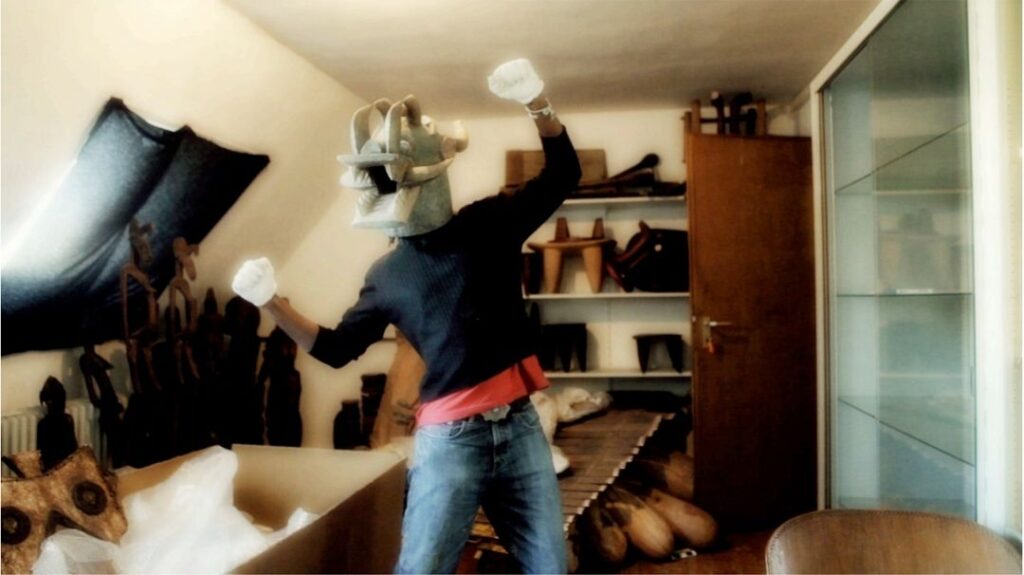
In 2015, Kenyan artist Otieno Gomba reanimated a Senufo mask in Iwalewahaus, Bayreuth’s archival storage, by performing in it. This marked a reimagining and reactivation that restored its ritual vitality, if only temporarily, thereby providing new meaning and reading as well as a distinct, new way of self-representation without severing historical continuity.
The final destiny of the archive, as he notes, is outside of its own materiality.
While identifying the hostile responses (legalism, paternalism, and recuperation) to even superficial calls for restitution, Mbembe’s critiques of existing calls for restitution include the fact of their gesturality rather than any serious, deeply considered, or extensive settlement, much akin to land acknowledgements by institutions on Native American lands in the United States. Even when recuperation is done, it’s often without proper ethical consideration.
For the historian, then, true restitution must go beyond the act of recuperation. It must occur as a “process rather than an act.” There must be a commitment to learn and remember together, and restitution must be centrally linked to the act of repairing. Ultimately, true restitution hinges upon a “debt of truth” that is “indelible’”and must “haunt us until the end of times.”