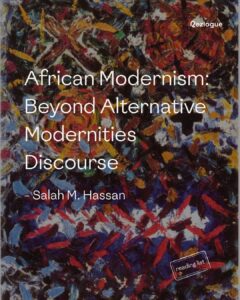
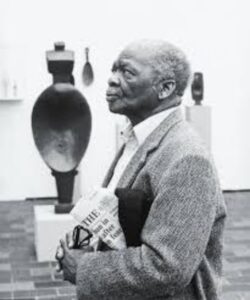
Against the backdrop of South African artist Ernest Mancoba’s illustrious itinerant art career, spent mostly in exile, Salah Hassan examines what constitutes ‘African’, Modernism, and African Modernism.
How are his questions useful for understanding African Contemporary Art today?
Salah Hassan wants us to understand “Africa” as an elusive concept, carrying complex meanings for different audiences. While it could primarily be seen as the affirmation of certain natural features, cultural characteristics, and values, peculiar to the geographic context of the continent, it is also essential to read Africa through lens of history: especially the experience of slavery and colonization and “ the resultant mass displacement and diasporization of African peoples and cultures, leading it to become a “delimited locale” leading it to assume a global geography.
As at 2010, when this essay was published, Hassan points out how discourse and scholarship around modernity are inherently eurocentric. a process that has categorised western modernisation as central and the social transformations and expressions of other regions as peripheral. Western hegemony has made us forget that Western Modernism (from renaissance to the present) stands on the shoulders of other cultures and civilisations. and ask us to examine any key Western metropolis (London, Paris…) to see how particularly African, Caribbean artists and writers have laid claim to these metropolises.


In trying to undo this hegemony, Hassan is cautious. He warns that claiming “alternative” or “parallel” modernities outside the West risks reinforcing Western modernity as the standard and placing others in a permanent “outside” category. He highlights Stuart Hall’s proposition as a more hopeful approach, which abandons the centre–periphery binary in favour of a plurality, a “multitude of modernities” that are not parallel or secondary, but simultaneous, entangled, and interacting.
African modernism is a historically produced, politically charged, and globally entangled formation that emerges from the intersections of:
- Nationalism (decolonization, self-making, nation-building)
- Internationalism (Leftist solidarities, global ideological exchange)
- Transnationalism (diaspora, the Black Atlantic, cultural circulation)
- Colonial entanglement (Western education, patronage, institutional frameworks)
- Resistance (reclaiming modernity and representation).
In thinking about the contemporary? Do we encounter similar hegemony? Or is the project of Salah Hassan and Stuart Hall successful?