What project were you investigating or developing during your residency?
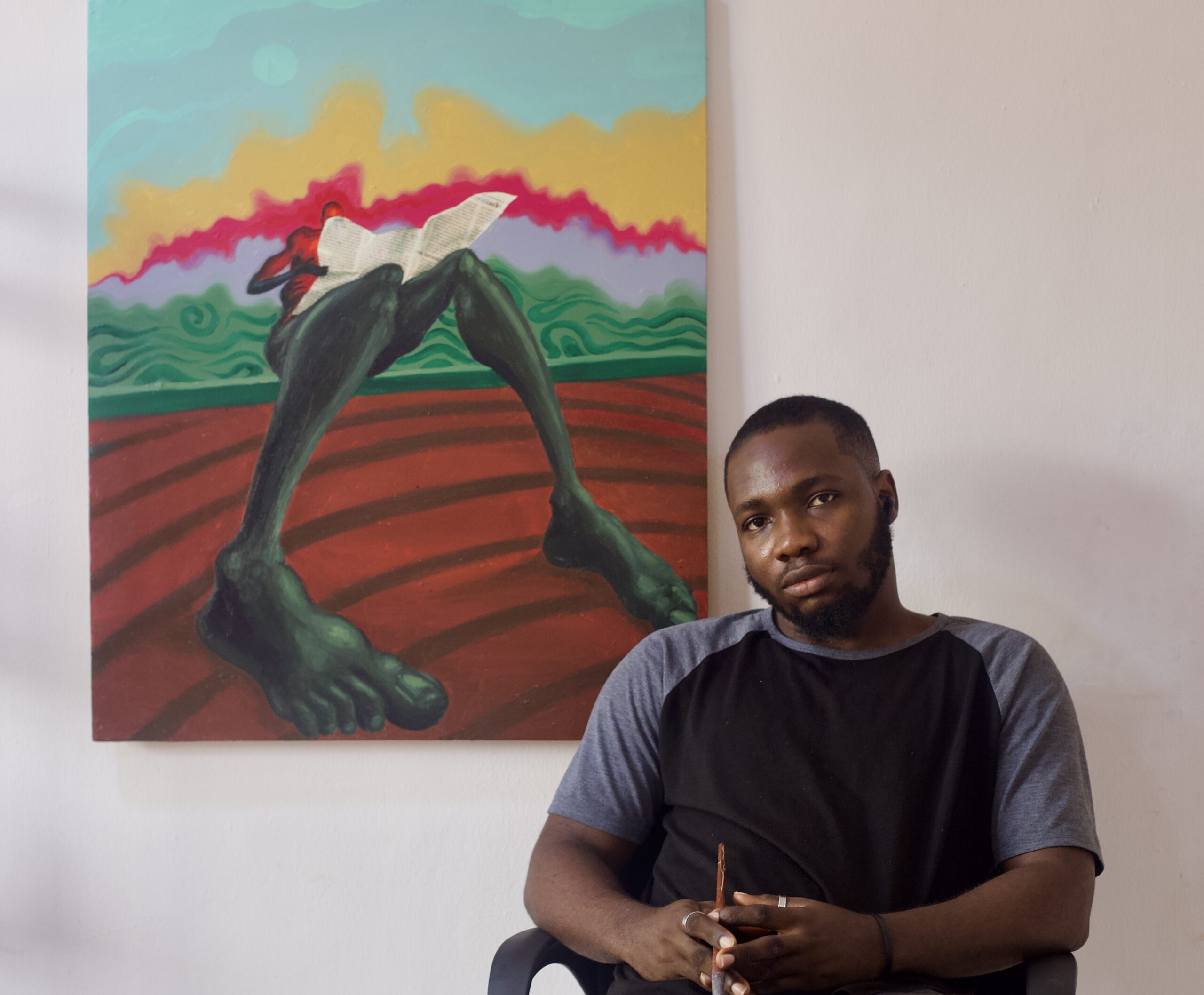
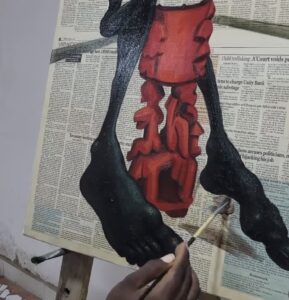
My work is centered on my lived experiences and the trajectory of human life, our experiences and how we tend to journey through time. But in Abeokuta, I wanted to investigate how communication has evolved with the newspaper culture because the first newspaper publication in Nigeria started in Abeokuta with Iwe Irohin. It started in Abeokuta with Henry Townsend as the publisher. It was this religious newspaper that was positioned to instill morals into the people and also helped the people draw closer to God. So, I wanted to research the way information has passed down through the history of Nigeria and how communication has evolved.
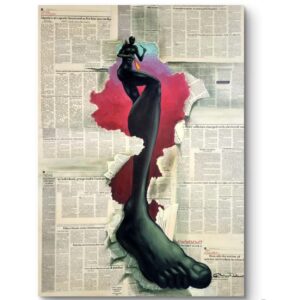
For this work, I wanted people to see the relationship between the feet and the newspaper. The feet represent my journey and the trajectory of which my life has taken to where it is now, and also symbolizes how the communication era journeyed from one point to another, to where it is now. I didn’t select specific news text to match the concept because the newspaper covers a range of events and themes and everyone can find something to connect with. I want people to converse with the work so that it leads them to a particular conclusion within the context of their own lives.
What was your relationship with Abeokuta before the residency? And what was different about the residency? What did the residency offer you, and how did that influence your work?
I’m from Kogi State, and I schooled in Enugu but I had come to Abeokuta for a while after secondary school. I wanted to practice my art. I felt like if I didn’t practice in that period university, I would lose interest in an arts career. A family friend gave me a church project and that really brought me joy. I got the first platform to actually practice my art in the outside world. People saw it, people interacted with it, and people were happy. People were interested in knowing more about me as a person. I felt like I needed that moment, because if not, maybe I would not be doing art today.
But coming to Abeokuta for the residency was a whole new experience, because the times I had experienced Abeokuta before, I was staying with family friends, but having to stay at the residence, I focused on my craft with no disturbance. I was allowed full focus to do what I was doing, interacting with creative minds around. It was a whole new experience, and this was my first residency. So, getting my first art platform after secondary school in Abeokuta back then, and getting my first residency in Abeokuta, it sparks a connection. It was so wholesome. I enjoyed the experience. No disturbance, everywhere was calm. The environment was helpful, and the people were also helpful. That was a good one for me.
Were there any conversations in Abeokuta that directly shaped your work, your process, materials, or what you wanted to address??
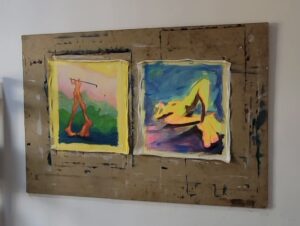
I created about seven pieces during the residency, some small pieces and some miniature works but one of them is what I called a gossip work and it was a crystallisation of my experience with Abeokuta over the years. It represents aspects of communication by mouth, mouth to ear, mouth-to-mouth communication, and how people converse with each other. But it’s also about miscommunication.
Because Abeokuta is like a family environment, especially when you’re in a church environment there. People tend to gossip and information gets lost in transfer. So I pictured that work as diptych – the one communicating the information had the newspaper placed upside down, while the one listening was standing upright and the newspaper standing upright for you to read.
So the instance there is: I, the one telling the story, know what the story is, but I chose to turn it upside down. But the person listening to it would think that is the real story. So even if he’s going to tell it to another person truthfully, the way he heard it, he is going to be telling a totally wrong story, because it’s been turned upside down.
Did any new ideas emerge during the residency?
The Conductor Series is also about my experience coming to Lagos, with the yellow buses and the conductors chanting here and there. There was an experience I had where I went out, and just a conversation, a struggle between me and a conductor, rendered my whole day useless. I was unnecessarily angry that day for no reason. It’s different from Abeokuta, which is much calmer, with less buses and rarely any conductors. So I want to capture the power that those conductors have, because people disregard them. But they are much more powerful than we think they are. Because they can render your whole day useless with one action and you can find yourself in situations you’d rather not.
Is there any book you’re reading right now, or any conversation, film, or piece of media that’s inspiring you currently?
Conversations I had with people during the residency that inspired me a lot. I also had conversations with Duke Asidire and Ben Ukasi which also inspired me. And personally, I do watch some videos online of philosophies of people, their thought processes. Those also inspire me.