Sometimes, growth in an artist’s practice comes not from pushing forward, but from pausing and returning. In this conversation, Tolu reflects on a workshop experience that offered exactly that: a space to slow down, reconnect with making, and rethink the direction of their work.
Rezlogue: How did your time at this workshop shift, expand, or challenge your practice?
Tolu: For a long time, my practice has been rooted in performance and in my work as an art educator and project manager. I realised I had drifted further towards administrative work and away from the foundations of my artistic practice—drawing, making, and having dedicated studio time.
I had become deeply invested in working with the body as a primary site of inquiry, which was valuable, but it also meant I was quite closed-minded and not allowing myself to express myself as widely as I could. This workshop allowed me to return to those origins. It felt like a quiet but necessary recalibration.
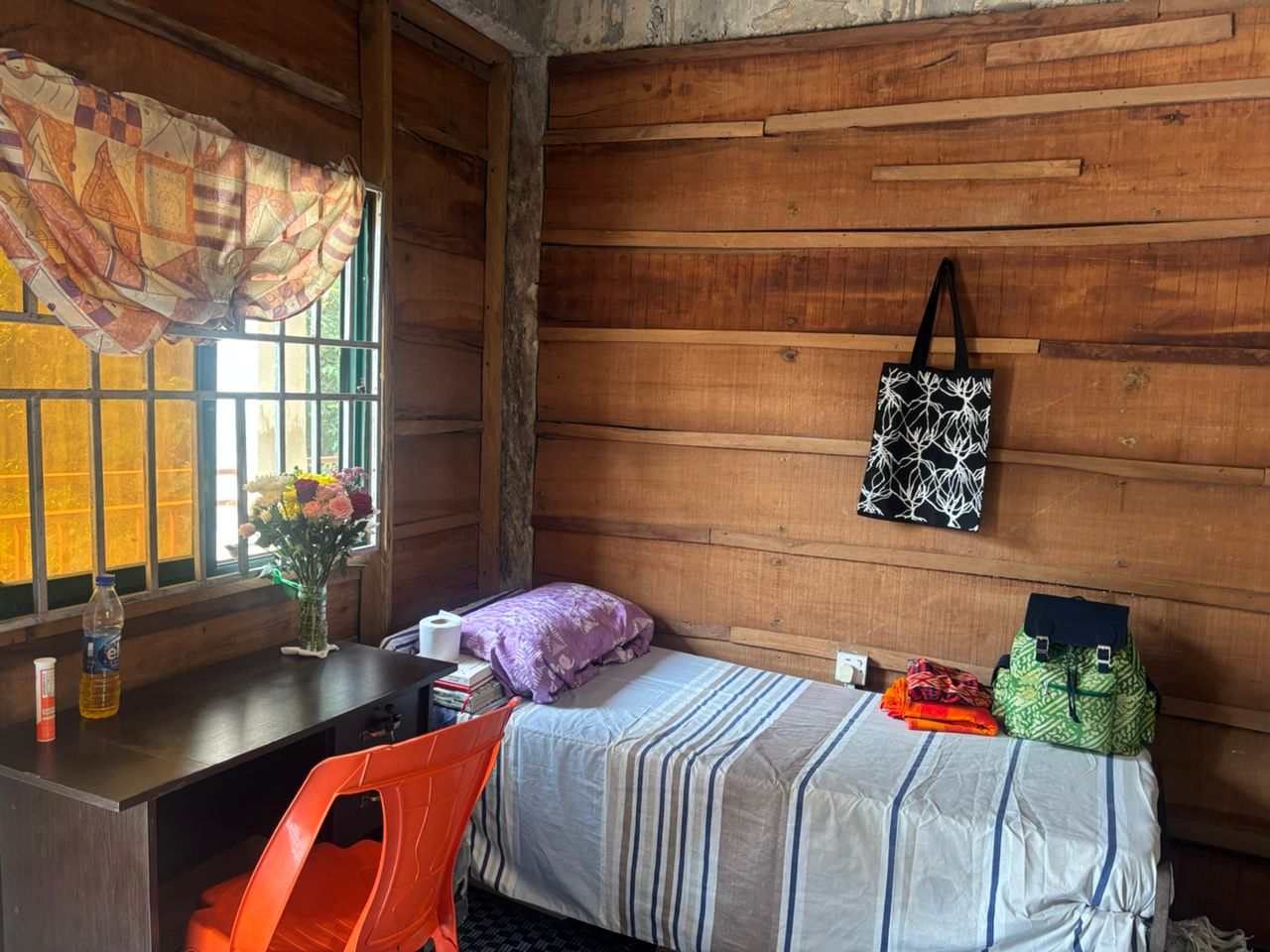
Being in that environment also reconnected me with nature in a way I hadn’t experienced in a while. Coming from Lagos, where everything moves quickly and constantly, the stillness of the space allowed me to settle. That sense of slowness and presence had a direct impact on how I approached making—it became less urgent, more attentive, and more grounded.
Rezlogue: What kind of support during the workshop was most meaningful to you?
Tolu: Support showed up in both practical and communal ways.
On a very practical level, being cared for—having meals provided consistently—was incredibly meaningful. It created a structure where I didn’t have to think about the logistics of looking after myself, and could instead focus fully on my practice. That kind of care is often overlooked, but it makes a significant difference.
Equally important was the community of participants. What stood out was the range of experiences and backgrounds—there were professors, practising artists, and people who had come to art through different paths. There was no hierarchy, just a shared commitment to learning and making.
In my printmaking group, this was especially impactful. Some participants had years of experience—even returning as participants after facilitating in previous years—while others were encountering printmaking for the first time. This created a generous learning environment where knowledge circulated freely. For me, revisiting printmaking—something I had encountered during my time at Yabatech—felt like both a return and a deepening. Being able to experiment with multiple techniques in such an open setting was incredibly valuable.
Rezlogue: Were there any local materials, histories, or conversations that found their way into your work?
Tolu: While I wasn’t directly working with local materials in a traditional sense, the environment itself—particularly the presence of trees—deeply shaped my work.
I became increasingly interested in the relationship between human beings and nature, and this led me to develop a body of work centred on trees. I was thinking about connection in a very physical and symbolic way—how we exist in a symbiotic relationship with the natural world, even when we try to distance ourselves from it.
I spent time observing and drawing trees within the compound, paying attention to their structures—the trunks, branches, and root systems. This exploration resulted in a body of work titled Ground thy self, a phrase that stayed with me after encountering it at the “Dreaming New Worlds” exhibition by the Goethe-Institut shortly before leaving Lagos.
Another significant influence was my interaction with Baba Bruce Onobrakpeya. I went to the Harmattan workshop with an existing curiosity about his Ibiebe symbols and ideograms. Through conversations with him, I became more aware of his symbolic visual language and how it emerged. Learning that many of his forms were inspired by close observation of nature—particularly the patterns within leaves—was deeply affirming. While my focus leaned more toward the structural elements of trees, his attention to detail opened up new ways of seeing for me.
Those exchanges shifted something in me. They expanded how I think about observation, translation, and how natural forms can evolve into visual language—something I’m now interested in exploring further through printmaking.
Rezlogue: What is currently inspiring your thinking or practice?
Tolu: At the moment, I’m inspired by a combination of conversations, experimentation, and reading.
My time engaging with Baba Bruce’s work and ideas continues to stay with me. Encountering works from as far back as the 1970s and 80s, and seeing the consistency and evolution of his visual language, has been deeply motivating.
I’m also currently reading Tiny Experiments, by Anne-Laure Le Cunff, which has been quite transformative. It encourages a shift from being outcome-driven to being process-led and leaning into the exploration of my curiosity —something that already resonates strongly within my performance practice and hints at where my overall practice as an artist is headed right now.
I have observed my very process-oriented career evolve into something more multilayered and complex. Growing from pure performance to the inclusion of performance documentaries and sculpture installations. Yet again, I find myself at that familiar point of evolving. And right now, I feel at ease occupying a space of curiosity. I’m allowing myself to experiment in the studio without the immediate pressure of outcomes or expectations. That freedom to make, to explore and to follow instinct is what is currently driving my practice. This is a gift and privilege I do not take for granted.